Emotional Sympathetic and Parasympathetic Shock
Based on the practice of Heart-Centred Therapies and the research
of Diane Zimberoff, LMFT + David Hartman, LCSW. Compiled and composed by Jude Wong, MPCC, HCH. Copyright 2022.
Emotional shock in Heart-Centred Therapies is essentially a survival mechanism, in the face of intense and overwhelming emotions during a traumatic, or unprocessed, event. Left unprocessed, these big emotions become stuck or trapped in the nervous system. When we encounter sensory stimuli or social situations that remind us of the unprocessed event, the unprocessed emotions can flood our nervous system, overwhelming us again, resulting in the shock response that originally protected us from these feelings.
Various levels of emotional shock can remain with us semi-permanently, until the original event is processed. In the research of Heart-Centred Therapies, emotional shock that has become normalized, or chronic, has been found to be at the heart of chronic conditions — mental, emotional, and physical ones. Unprocessed emotional material shows up indirectly, where direct processing has not been possible.
The Life-Giving Force
Most people carry a degree of unprocessed emotional material. It may manifest in relationship or life patterns, sleep issues, and other various health challenges. Heart-Centred Therapies might propose that this process is an ingenious human mechanism, viewing trauma as an innate, life-giving force of renewal and resilience.
The Two Types of Emotional Shock
When the nervous system becomes overwhelmed, it either races into over-drive, with the fight or flight response or shuts down, almost literally becoming frozen in the freeze response. We can feel slightly disconnected in either form of emotional shock, from ourselves and/or from our environment, and may have a sense of being out of control or somehow not ourselves. There is often a change in breath, heart-rate, and body temperature or a sensation of ‘everything going blank.’
- Fight or Flight response: Racing thoughts, racing heart, raised body temperature, fast breath, heightened or continuous physical motion or talking. Lashing out in anger to defend yourself or hurt the other, or storming out of the room. Heightened senses of smell, sound, things moving very fast.
- Freeze response: Mind going blank, slowed heart and breath, lowered body temperature, and a heavy, numb, or “dead” feeling in the body. Confusion, wanting to disappear, or give up. Ambivalence to pain. Things in slow motion, or muted.
At its extremities, acute emotional shock can include auditory and visual distortions, such as walls moving or rooms shrinking, not hearing any sound, or seeing red; disorientation, nausea, dizziness, or panic attacks. Unprocessed shock can become chronic, or normalized, and is often found to be at the heart of physical illness + chronic disease.
Caution: Intense emotion is not necessarily shock
Shock is when intense emotions are not flowing in a healthy way — ie. Stuck, frozen, destructive, isolating, or entirely absent. On the other hand, healthy emotional expression leads to a greater sense of connection.
Care for Emotional Shock
1. Acknowledge the shock response to yourself and/or to Others where appropriate: “I’m having a shock response.” or “Excuse me, I just need to take a moment.”
2. Make space and take time to stay present with the emotions and sensations you are feeling, either by yourself or with a trusted other.
3. Respond to the nervous system (if unsure, ask the body which of these—more information is below):
a. ICE for sympathetic (fight,flight) response
b. HEAT for parasympathetic (freeze) response
4. Name the core emotion(s) of this response, and the particular event or stimuli that initiated it. Do these relate to an experience in your personal or family history. Simply name + acknowledge these.
5. Move the energy out of the body: Give vocal, verbal, and physical expression to the emotion — You might breathe or sound the emotion into a pillow, hit or throw it against a wall, or embody a physical shape that expresses it.
6. Recover the Senses (Soothe the nervous system)
* Drink/bathe in/or splash some water on your face
* Scents, sounds, textures, sensations, music that comfort you
* Physical movement (stretch, breathe, rebalancing exercise)
7. Share and reconnect: Is there anyone you need to reconnect with, or acknowledge; anything that needs to be shared, for you to feel connected again.
Use of Ice + Heat
An icepack with a towel or cloth around it; a heating pad, hot water bottle, or extra warm blanket(s). Whatever your source of temperature, you can ask where it needs to be placed. Common areas are:
* Top of head * Forehead * Back of neck/shoulders
* Upper chest * Centre of torso * Abdomen or groin
© 2022 Jude Wong, RPC=C, HCH
Read More
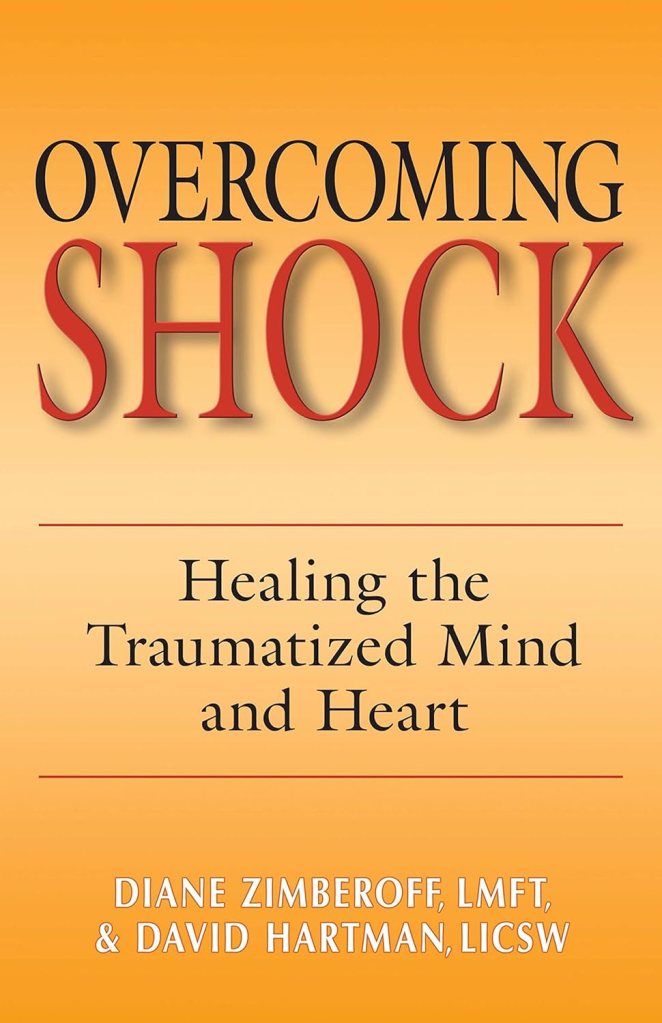
Diane + David’s book is available on Amazon.ca.
Clicking on this image is will take you there.
 Open Session Space